
Geopolitical Storm: Markets Face the March 2026 Shock

As the conflict triggered in late February settles in for the long haul, financial markets are navigating a zone of turbulence marked by soaring energy prices and a resurgence of inflation. Between the anticipated tightening by central banks and the correction in risky assets, investors are searching for their footing. Yet, behind the immediate volatility, anchors and long-term opportunities are emerging, suggesting a need for caution rather than panic.
As the conflict triggered in late February settles in for the long haul, financial markets are navigating a zone of turbulence marked by soaring energy prices and a resurgence of inflation. Between the anticipated tightening by central banks and the correction in risky assets, investors are searching for their footing. Yet, behind the immediate volatility, anchors and long-term opportunities are emerging, suggesting a need for caution rather than panic.
Since the start of the conflict on February 28th, the economic and financial landscape has, to say the least, changed significantly. This is especially true as the war—which Israelis and Americans likely expected to last only a few days—is still ongoing.
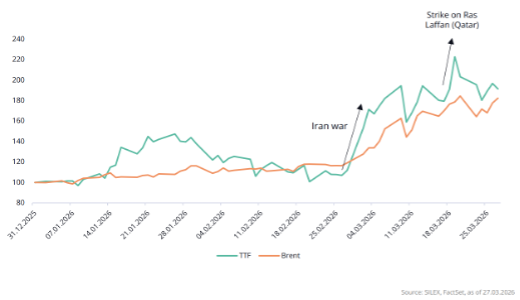
The result: a roughly 50% surge in gas and oil prices (with a sharp rise in fertilizer and food prices undoubtedly to follow) and a marked rebound in interest rates due to significantly higher inflation outlooks. For instance, the yield on French 10-year bonds quickly rose from 3.2% to 3.8%.
Increase in gas (TTF) and oil (Brent) prices in Europe since the beginning of the year:
Financial upheaval and the Central Bank dilemma
All of this has led to a combined decline in both bonds and equities. In this context, finding a safe haven was difficult; even gold fell by more than 10%! Only the dollar gained some ground, rising about 3% against the euro.
Furthermore, a new source of uncertainty stems from these events: what will the central banks' stance be? Specifically the ECB, which seems to be preparing the ground for several rate hikes to combat inflation. However, the bank risks acting too quickly, as it did in 2008 and 2011, ultimately triggering a sharp economic slowdown or even a recession.
It is true that inflation in the Eurozone rose from 1.9% in February to 2.5% in March, but this is entirely due to rising energy prices—a phenomenon that could reverse if the conflict is resolved. One caveat remains: regardless of the outcome, experts agree that bringing stopped or damaged infrastructure back online will take several months.
Resilience and opportunities: why we shouldn't succumb to panic
However, for those choosing to see the glass as half full, there are reasons for hope:
-
Converging Interests: No one (except Russia and certain oil-producing nations) has an interest in this situation dragging on—not Europe or Asia, which are major energy importers, nor even the United States, where consumers are feeling the full brunt of rising gas prices and where the midterm elections already look challenging for Donald Trump.
-
State Support: Governments have the means to support their economies: tax cuts in the U.S., investment plans in Germany and Japan, and consumption support in China.
-
Attractive Valuations: Naturally, from an investment standpoint, valuations are now more attractive for both bonds and equities. This allows for strengthening these asset classes within portfolios, at the expense of money market funds whose yields remain very low.
-
Emerging Market Growth Drivers: Emerging markets could emerge as winners from this conflict, either through rising commodity prices (notably in Latin America for oil and agriculture) or due to their relative geopolitical stability (particularly in Asia).
Finally, let us put the decline in equity markets into perspective: it started from a high point, and its magnitude remains below 10% on average for the major indices. One could even argue that markets are holding up relatively well so far. There is no reason to panic, nor to rush into buying. Given the lack of visibility regarding future events, it would be "urgently" wise to wait.
From Switzerland, the perspective of our Geneva-based partner: When thinking of safe havens, the Swiss franc often joins gold and the dollar in the top three. The strength of the Swiss franc has been evident for many years, so much so that the Swiss National Bank (SNB) sells francs massively to combat its appreciation. At its last meeting, the SNB indicated that it does not rule out a return to negative interest rates.