
Artificial Intelligence: A Shield Against Geopolitical Shocks?

Despite persistent tensions in the Middle East and inflationary pressures, financial markets are showing defiant resilience. Driven by the euphoria surrounding AI and record corporate earnings, the US economy seems—for now—to be decoupling itself from geopolitical turbulence and rising interest rates.
Despite persistent tensions in the Middle East and inflationary pressures, financial markets are showing defiant resilience. Driven by the euphoria surrounding AI and record corporate earnings, the US economy seems—for now—to be decoupling itself from geopolitical turbulence and rising interest rates.

What a month of April! While the conflict in the Middle East shows no sign of abating, equity markets are hitting all-time highs.
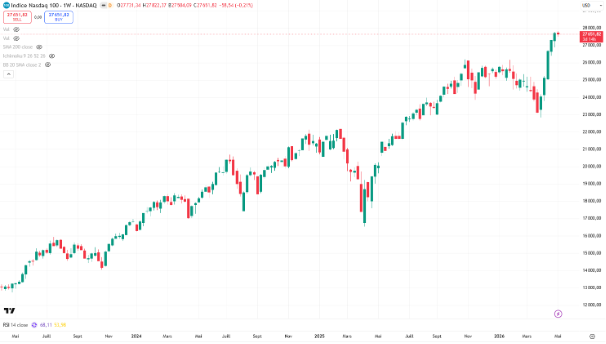
This was particularly evident in US markets, which recorded their best month in five years, with gains of approximately 10% for the S&P 500 and nearly 20% for the Nasdaq. These new records were fueled by strong corporate results and encouraging economic indicators.
The AI Juggernaut and American Economic Vigor
Among the highlights, the enthusiasm for semiconductors, data centers, and AI in general remains unshakable. Demand, and consequently investment, shows no signs of slowing down. This is bolstering growth for sector leaders, as evidenced by the strong earnings reported by Alphabet, Microsoft, Texas Instruments, Qualcomm, TSMC, ASML, Micron, Intel, and Amazon.
Since these advancements require colossal capital expenditure, they are also driving broader US economic growth. GDP grew by 2% in the first quarter, compared to just 0.1% in the Eurozone. The takeaway: despite a grim geopolitical backdrop, the American economy is holding steady.
Nasdaq Index Evolution over 3 years:
The Shadow of Inflation and the Interest Rate Paradox
However, the war in the Middle East is proving much longer than expected, and oil prices remain the market's primary stress variable. While the US is better positioned as a net exporter of oil and gas, American consumers are still feeling the pinch of rising prices.
The fallout is already significant: inflationary pressures, declining household morale, and interest rates hitting 10-year highs. Central banks are watching their room for maneuver vanish "like snow in the sun." Although the Fed and the ECB maintained rates at their last meetings, they could be forced to hike them further if the situation in the Middle East does not improve.
Ultimately, the stock market's surprising health is explained by strong quarterly earnings, high cash reserves held by investors, and, above all, the "Fear Of Missing Out" (FOMO) on the AI train.
On the other hand, interest rates are climbing across the board for both corporate and sovereign debt. Whether looking at short-term rates (the US 2-year yield is approaching 4%) or long-term rates: the French 10-year yield stands at 3.7%, the US at 4.2%, and the UK has surpassed 5%.
Inevitably, higher rates are expected to cool economic activity and increase debt-servicing costs. They also weigh on bonds, which have posted flat or negative returns since the start of the year. That said, one could choose to see the glass half full: at these levels, fixed-income investments are becoming increasingly attractive once again.