
Investors Bet on Innovation and Growth

Despite a tense geopolitical context and economic uncertainties, financial markets are showing remarkable calm. Driven by the rise of artificial intelligence and U.S. growth prospects, investors continue to place their bets on innovation.
Despite a tense geopolitical context and economic uncertainties, financial markets are showing remarkable calm. Driven by the rise of artificial intelligence and U.S. growth prospects, investors continue to place their bets on innovation.
 Surprisingly Calm Financial Markets
France is without a government, the war in Ukraine drags on relentlessly, new tariffs are being announced, a seventh planetary boundary has just been crossed, and the United States is bracing for yet another budget shutdown… and yet, financial markets remain unmoved. They take refuge in the strong health of the U.S. economy, fueled by massive investments in artificial intelligence.
The figures are staggering: Nvidia plans to invest $100 billion in OpenAI, Oracle has announced $455 billion worth of orders, Anthropic (and its AI “Claude”) raised $13 billion and is now valued at $183 billion… But what is not artificial is the contribution of all these investments to U.S. economic growth: this contribution is becoming significant and is no stranger to the projected 3.8% GDP growth in the second quarter.
So much calm in the markets this September! A slight rise in equities, relative stability in interest rates and currencies. Even cryptocurrencies barely moved. Ah, yes—one notable exception: gold, which rose more than 10%, likely still driven by geopolitical risks but also by the Federal Reserve’s decision to launch a new series of rate cuts.
Europe Holding Back, America Resilient
In Europe, growth remains weak but relatively stable. Moreover, the first spending under the German stimulus plan may be implemented a little sooner than expected.
In the United States, the economy remains resilient and inflation is hovering around 3%, above the 2% target. This remains a medium-term risk, given that the tariff hikes have not yet been fully implemented.
That said, the labor market has been weakening for several weeks. The Federal Reserve has therefore finally resolved to cut rates (by 0.25%), as expected. However, the suspense lay in the outlook: projections point to two more imminent rate cuts. This would lower borrowing costs for households and businesses alike, boosting consumption and investment.
In the meantime, this has provided fertile ground for the continuation of the rally in U.S. equities, particularly in the technology and AI sectors. However, debates are intensifying around this theme: what will be the long-term profitability of these investments? Who will be the winners and losers? Are valuations already excessive?
Identified Growth Drivers
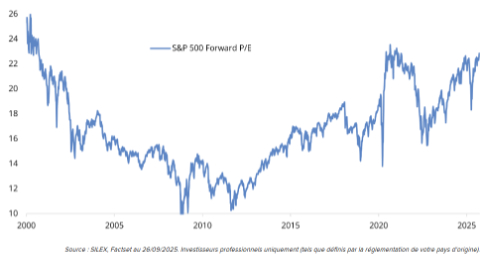
Speaking of valuations, the chart below shows the evolution of the P/E ratio (which divides market capitalization by earnings) for the U.S. S&P500 index since 2000: there is no doubt that it is currently at elevated levels.
This does not mean that equity markets are bound to fall, but it does mean that growth must continue to deliver in order to sustain the rally.
S&P 500: Price to earnings ratio for the next 12 months
For that, investors are counting on four key drivers:
- AI and the productivity gains it can deliver;
- rising industrial investment within the U.S. by companies seeking to avoid tariffs;
- rate cuts by the Federal Reserve;
- reduction of the trade deficit, through both higher tariffs and growing exports, supported by a weaker dollar (already down nearly 15% against the euro since the start of the year).