
Markets Hesitate Between Earnings Growth and Rising Interest Rates

Driven by solid earnings momentum and heavy investment in AI, corporate balance sheets are holding up against the deteriorating global environment. However, the dramatic surge in interest rates is reviving financial tensions and calling for extreme caution across the markets.
Driven by solid earnings momentum and heavy investment in AI, corporate balance sheets are holding up against the deteriorating global environment. However, the dramatic surge in interest rates is reviving financial tensions and calling for extreme caution across the markets.

So far, so good… at least in terms of economic growth, which is performing remarkably well. It continues to show strong resilience, particularly in the United States and emerging economies, and to a lesser extent in Europe. While stepping back from the delicate situation France currently faces, OECD forecasts now project Eurozone GDP growth at 1% for this year (up from a 0.8% forecast three months ago), while global growth expectations have also been revised slightly upward to 2.9%.
On paper, however, the backdrop remains challenging: surging energy and commodity prices, overindebtedness across developed economies, and a cloudier geopolitical horizon. Xi Jinping’s recent visit to the United States did little to alter this picture. Although the truce on trade tensions was extended until January 10, 2027, fundamental disputes remain, and the two superpowers essentially agreed only to keep communication lines open.
Solid Earnings Amid the Bond Market Shock
Overall, corporate earnings growth remains strong, partially supported by the energy, defense, and technology sectors — the latter fueled by massive capital deployment into the AI revolution (we will address the potential risks of this trend another time).
As a result, equity markets are standing firm despite the sharp rise in yields. Investors are essentially betting that future profit growth will outpace the rising cost of capital.
On that front, conditions are becoming increasingly strained. The US 10-year yield is trading around 5.3%, reaching its highest level since July 2007:
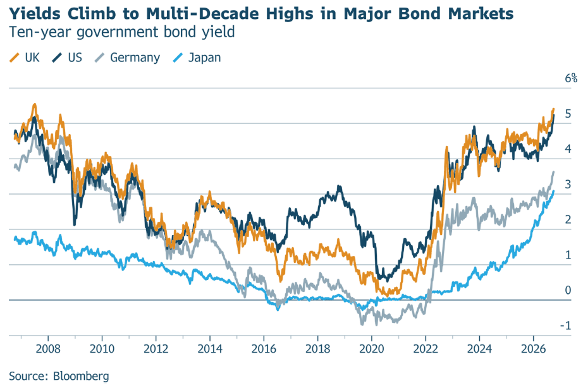
Tensions are equally visible in Europe, with the German Bund yield standing at 3.60% and the French OAT at 4.9%. This brings the France-Germany spread to 130 basis points — a level unseen since the Eurozone sovereign debt crisis in 2012.
Three Threats Brought by Higher Rates
Three major implications of these elevated interest rates stand out:
-
A drag on investment and consumer spending, weighing on overall economic activity;
-
Higher debt-servicing costs across all sectors (governments, corporations, and households);
-
Bonds now offer a compelling alternative to equities, especially given the relatively stretched valuation levels in equity markets (particularly in the US).
The takeaway: Equity risk premiums offer little cushion. A easing of pressures on geopolitics, energy, inflation, or interest rates would provide welcome relief to the markets. For now, portfolio management calls for prudence and increased diversification across both geographic regions and asset classes.